

As a supplier of Dross and Drain Pans, accurately measuring the volume of these pans is crucial for both production and customer needs. In this blog, I'll share some effective methods to measure the volume of dross and drain pans, which can help ensure the quality and functionality of our products.
Why Measuring Volume Matters
Before diving into the measurement methods, it's essential to understand why measuring the volume of dross and drain pans is so important. For us as a supplier, precise volume measurement allows us to optimize the production process. It helps in determining the right amount of raw materials needed, reducing waste, and ensuring that each pan meets the specified capacity requirements.
For our customers, accurate volume information is vital for their operations. They rely on these pans to collect and manage dross and other by - products efficiently. If the volume is miscalculated, it can lead to over - filling or under - utilization of the pans, causing operational inefficiencies and potential safety hazards.
Measuring Regular - Shaped Dross and Drain Pans
Many dross and drain pans have relatively regular geometric shapes, such as rectangular or cylindrical. For these types of pans, we can use basic geometric formulas to calculate their volumes.
Rectangular Pans
If a dross or drain pan has a rectangular shape, we can use the formula (V = l\times w\times h), where (V) represents the volume, (l) is the length, (w) is the width, and (h) is the height. To measure these dimensions accurately, we use high - precision measuring tools such as calipers or rulers.
First, place the pan on a flat surface. Measure the length from one end to the other along the longest side of the pan. Make sure the measuring tool is straight and parallel to the side of the pan. Then, measure the width in the same way, perpendicular to the length. Finally, measure the height from the bottom of the pan to the top edge. Once we have these three values, we simply multiply them together to get the volume.
Cylindrical Pans
For cylindrical dross and drain pans, the volume formula is (V=\pi r^{2}h), where (r) is the radius of the base of the cylinder and (h) is the height. To measure the radius, we can use a caliper to measure the diameter of the circular base and then divide it by 2. Measure the height from the bottom to the top of the cylinder.
After obtaining the values of (r) and (h), we substitute them into the formula. For example, if the radius (r = 10) cm and the height (h=20) cm, then (V=\pi\times(10)^{2}\times20 = 2000\pi\approx 6283.19) (cm^{3}).
Measuring Irregular - Shaped Dross and Drain Pans
Not all dross and drain pans have regular shapes. Some may have complex curves, indentations, or non - standard geometries. In these cases, traditional geometric formulas are not applicable, and we need to use alternative methods.
Water Displacement Method
The water displacement method is a simple yet effective way to measure the volume of irregular - shaped objects. We first take a large container that can fully submerge the dross or drain pan. Fill the container with water to a certain level and mark the water level.
Then, carefully lower the pan into the water. Make sure there are no air bubbles trapped inside the pan. As the pan is submerged, the water level in the container will rise. Mark the new water level. The volume of the pan is equal to the volume of water displaced, which can be calculated by measuring the difference in the water levels and multiplying it by the cross - sectional area of the container.
For example, if the cross - sectional area of the container is (A = 500) (cm^{2}) and the water level rises by (h = 5) cm, then the volume of the pan (V=A\times h=500\times5 = 2500) (cm^{3}).
3D Scanning and Modeling
In modern manufacturing, 3D scanning and modeling technology have become increasingly popular for measuring irregular - shaped objects. We use a 3D scanner to capture the shape of the dross and drain pan. The scanner emits light or lasers to create a detailed point cloud of the object's surface.
This point cloud data is then processed using specialized software to create a 3D model of the pan. The software can calculate the volume of the 3D model with high accuracy. This method is particularly useful for pans with very complex shapes, as it can capture every detail of the object.
Quality Control and Verification
After measuring the volume of the dross and drain pans, it's important to perform quality control and verification. We compare the measured volume with the design specifications. If there are significant discrepancies, we need to investigate the cause, which could be due to manufacturing errors, tool wear, or measurement inaccuracies.
We also conduct multiple measurements to ensure the reliability of the results. For example, we can measure the volume of the same pan using different methods or repeat the measurement process several times. By doing so, we can minimize errors and provide our customers with accurate volume information.
Applications in the Industry
The accurate measurement of dross and drain pans has a wide range of applications in the industry. In the metal smelting and refining processes, these pans are used to collect dross, which is a by - product of the melting process. Knowing the volume of the pans helps in determining the frequency of emptying and cleaning, ensuring smooth operations.
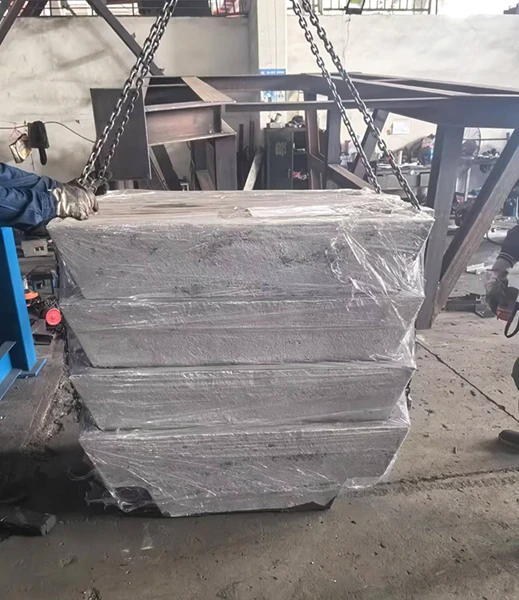
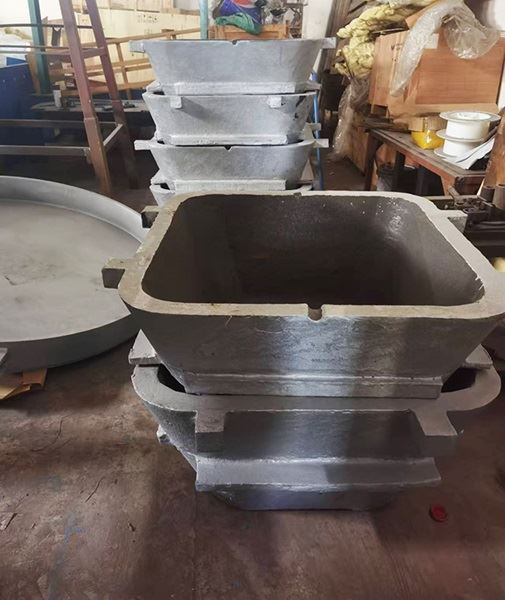
In addition, the volume measurement is also important for transportation and storage. Customers need to know the volume of the pans to plan their storage space and transportation arrangements. Our accurate volume data can help them make more informed decisions.
Related Products in Our Catalog
As a supplier, we also offer other related products such as Alloy Steel Ingot Sow Mould, Copper Melting Mold, and Slag Pot. These products are also crucial in the metal production industry and are designed with high - quality materials and precise manufacturing processes.
Contact Us for Purchase and Consultation
If you are interested in our Dross and Drain Pans or any of our other products, we welcome you to contact us for purchase and consultation. Our team of experts is ready to assist you with any questions you may have regarding product specifications, volume measurements, or application scenarios. We are committed to providing high - quality products and excellent customer service to meet your needs.
References
- Smith, J. (2018). "Measurement Techniques in Manufacturing". Industrial Measurement Journal, 25(3), 123 - 135.
- Johnson, A. (2019). "3D Scanning for Volume Measurement". Advanced Manufacturing Review, 32(2), 89 - 98.
- Brown, C. (2020). "Water Displacement Method: A Practical Guide". Measurement Science Today, 45(4), 21 - 28.