

In the realm of construction and mining, cone crushers play a pivotal role in the crushing process. These machines are designed to break down large rocks into smaller, more manageable pieces, which are then used in various applications such as road construction, building materials production, and more. However, the efficiency and longevity of cone crushers heavily depend on the quality of their wear parts. As a leading Cone Crusher Wear Parts supplier, I understand the significance of adhering to high - quality standards. In this blog, I will delve into what the quality standards of cone crusher wear parts entail.
Material Quality
The foundation of any high - quality cone crusher wear part lies in the material from which it is made. The most commonly used materials for cone crusher wear parts include high - manganese steel, alloy steel, and composite materials.
High - manganese steel is a popular choice due to its excellent work - hardening properties. When subjected to impact and abrasion, the surface of high - manganese steel hardens, which helps to resist further wear. This material is particularly suitable for applications where the crushing process involves high - impact forces. For example, in large - scale mining operations where large rocks are being crushed, high - manganese steel wear parts can withstand the intense forces without significant deformation or wear.
Alloy steel, on the other hand, offers a combination of high strength and good wear resistance. By adding various alloying elements such as chromium, nickel, and molybdenum, the mechanical properties of the steel can be tailored to meet specific requirements. Alloy steel wear parts are often used in applications where the wear is more abrasive in nature, such as in the crushing of hard minerals.
Composite materials are a relatively new development in the field of cone crusher wear parts. These materials combine the advantages of different materials to achieve superior performance. For instance, a composite wear part might have a hard outer layer for wear resistance and a tough inner core for impact resistance. This allows the wear part to perform well in a variety of crushing conditions.
Dimensional Accuracy
Another crucial quality standard for cone crusher wear parts is dimensional accuracy. The wear parts must fit precisely into the cone crusher to ensure proper functioning. Even a small deviation in dimensions can lead to problems such as improper alignment, increased vibration, and reduced crushing efficiency.
During the manufacturing process, advanced machining techniques are used to ensure that the wear parts meet the specified dimensional tolerances. Computer - numerical - control (CNC) machining is commonly employed to achieve high - precision results. This technology allows for accurate cutting, shaping, and finishing of the wear parts, ensuring that they match the design specifications exactly.
For example, the mantle and concave, two of the most important wear parts in a cone crusher, must have the correct curvature and clearance. If the mantle is too large or the concave is too small, the crushing chamber will not function properly, leading to uneven wear and reduced productivity.
Heat Treatment
Heat treatment is an essential step in the manufacturing of cone crusher wear parts. It is used to improve the mechanical properties of the materials, such as hardness, toughness, and wear resistance.
The heat treatment process typically involves heating the wear parts to a specific temperature and then cooling them at a controlled rate. Different heat treatment methods, such as quenching and tempering, can be used depending on the material and the desired properties.
Quenching is a process where the wear part is heated to a high temperature and then rapidly cooled in a quenching medium, such as oil or water. This results in a hard and brittle structure. However, quenching alone can make the wear part too brittle and prone to cracking. Therefore, tempering is usually carried out after quenching. Tempering involves reheating the quenched wear part to a lower temperature and then cooling it slowly. This helps to relieve the internal stresses and improve the toughness of the wear part.
Proper heat treatment ensures that the wear parts can withstand the high - stress conditions in a cone crusher. For example, a well - heat - treated mantle will have a hard surface to resist abrasion and a tough core to absorb impact forces.
Surface Finish
The surface finish of cone crusher wear parts also affects their performance and longevity. A smooth surface finish reduces friction and wear, while also preventing the accumulation of debris and contaminants.

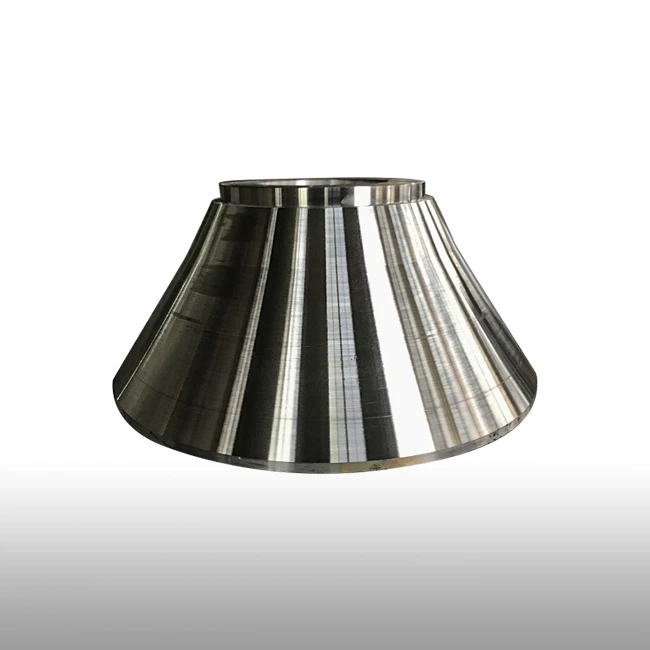
During the manufacturing process, various finishing operations are carried out to achieve the desired surface quality. Grinding, polishing, and shot - peening are some of the common methods used to improve the surface finish.
Grinding is used to remove any rough edges and irregularities on the surface of the wear part, resulting in a smooth and flat surface. Polishing further enhances the surface finish, making it even smoother and more resistant to wear. Shot - peening is a process where small metal shots are fired at the surface of the wear part. This not only improves the surface finish but also induces compressive stresses in the surface layer, which can enhance the fatigue resistance of the wear part.
Testing and Quality Control
As a Cone Crusher Wear Parts supplier, we implement a rigorous testing and quality control system to ensure that all our products meet the highest quality standards.
Non - destructive testing methods, such as ultrasonic testing and magnetic particle testing, are used to detect any internal defects or cracks in the wear parts. These methods can identify potential problems before the wear parts are installed in the cone crusher, preventing costly breakdowns and downtime.
Destructive testing, such as hardness testing and tensile testing, is also carried out to verify the mechanical properties of the wear parts. Hardness testing is used to ensure that the wear part has the correct hardness level, while tensile testing measures the strength and ductility of the material.
In addition to these tests, we also conduct performance testing in real - world conditions. Our wear parts are tested in actual cone crushers to evaluate their performance and durability. This allows us to make any necessary adjustments to the manufacturing process to improve the quality of our products.
Importance of Quality Wear Parts
Using high - quality cone crusher wear parts offers several benefits. Firstly, it improves the efficiency of the cone crusher. Well - designed and properly manufactured wear parts ensure that the crushing process is carried out smoothly, resulting in higher throughput and better - quality crushed products.
Secondly, high - quality wear parts have a longer service life. This reduces the frequency of wear part replacements, which in turn lowers the operating costs of the cone crusher. For example, a high - quality mantle and concave can last several times longer than a low - quality counterpart, saving both time and money in the long run.
Finally, using quality wear parts enhances the safety of the cone crusher operation. Poor - quality wear parts can fail unexpectedly, leading to accidents and injuries. By ensuring that all wear parts meet the highest quality standards, we can minimize the risk of such incidents.
Conclusion
As a Cone Crusher Wear Parts supplier, we are committed to providing our customers with products that meet the strictest quality standards. From material selection to testing and quality control, every step of the manufacturing process is carefully monitored to ensure that our wear parts offer superior performance, durability, and safety.
If you are in the market for high - quality cone crusher wear parts, or other related products such as Jaw Crusher Wear Parts and Crusher Spare Parts, please do not hesitate to contact us. We would be more than happy to discuss your specific requirements and provide you with the best solutions. Our Cone Crusher Wear Parts are designed to meet the diverse needs of the construction and mining industries, and we are confident that we can help you improve the efficiency and productivity of your cone crusher operations.
References
- "Handbook of Crushing" by Rolland A. Meyers
- "Materials Science and Engineering: An Introduction" by William D. Callister, Jr. and David G. Rethwisch
- Industry standards and guidelines for cone crusher wear parts manufacturing