

What is the influence of impact crusher wear parts on the particle size distribution of the crushed material?
Impact crushers are widely used in the mining, construction, and recycling industries to break down various materials into smaller particles. The performance of an impact crusher is significantly affected by the condition of its wear parts. As a supplier of Impact Crusher Wear Parts, I have witnessed firsthand how the state of these wear parts can influence the particle size distribution of the crushed material.
Understanding Impact Crushers and Wear Parts
Impact crushers work by using the principle of impact to shatter the material. The material is fed into the crusher and is struck by high - speed rotating blow bars or hammers. These blow bars or hammers are among the most critical wear parts in an impact crusher. Other important wear parts include aprons, liners, and rotor components.
Over time, these wear parts experience significant abrasion and impact forces. As they wear down, their ability to effectively crush the material changes, which in turn affects the particle size distribution of the final product.
The Role of Blow Bars in Particle Size Distribution
Blow bars are the primary components that come into direct contact with the material being crushed. When new, blow bars have a sharp and well - defined shape. This allows them to deliver a powerful impact to the material, breaking it into relatively small and uniform particles.
As the blow bars wear, their edges become rounded. A rounded blow bar has a reduced ability to penetrate and fracture the material. Instead of cleanly breaking the material into small pieces, it may cause the material to be chipped or cracked in an irregular manner. This results in a wider particle size distribution, with a higher proportion of larger particles in the crushed material.
For example, in a quarry operation where the goal is to produce a specific size of aggregate for construction purposes, worn blow bars can lead to an unacceptable amount of oversized particles. This not only affects the quality of the final product but also may require additional screening and re - crushing steps, increasing operational costs.
Aprons and Their Influence
Aprons in an impact crusher are used to control the size of the crushed material by adjusting the gap between the apron and the rotor. When the aprons are in good condition, they can be precisely adjusted to achieve the desired particle size.
However, as the aprons wear, their surface becomes uneven. This unevenness can cause inconsistent crushing forces across the material. Some areas of the material may be crushed more effectively, while others may pass through with less reduction in size. As a result, the particle size distribution becomes more variable.
Moreover, if the apron wear is severe, it may not be possible to maintain the correct gap setting. This can lead to a situation where the crusher produces either an excessive amount of fine particles (if the gap is too small) or a large number of oversized particles (if the gap is too large).
Liners and Particle Shape
Liners line the inside of the crusher chamber and protect the crusher body from wear. They also play a role in the crushing process by providing a surface for the material to bounce off.
New liners have a smooth and regular surface. This allows the material to bounce in a predictable manner, contributing to a more uniform particle size distribution. As liners wear, they develop grooves and irregularities. These irregularities can cause the material to bounce in an unpredictable way, leading to a less consistent crushing action.
The shape of the particles is also affected by the condition of the liners. Worn liners can result in more angular and irregularly shaped particles. While angular particles may be suitable for some applications, in others, such as asphalt production, a more rounded particle shape is preferred.
Rotor Components and Overall Crusher Performance
The rotor is the heart of the impact crusher, and its components, such as the rotor discs and shaft, are also subject to wear. A worn rotor can cause the crusher to operate less efficiently.
For instance, if the rotor is not balanced due to uneven wear of its components, it can lead to vibrations. These vibrations can disrupt the normal crushing process and affect the particle size distribution. In a vibrating crusher, the material may not be crushed evenly, resulting in a wider range of particle sizes.
The Importance of Regular Inspection and Replacement
To maintain a consistent particle size distribution, regular inspection of impact crusher wear parts is essential. By monitoring the wear of blow bars, aprons, liners, and rotor components, operators can determine when replacement is necessary.
Replacing worn wear parts in a timely manner can restore the crusher's performance and ensure that the particle size distribution of the crushed material meets the required specifications. This not only improves the quality of the final product but also reduces the need for additional processing steps, increasing overall efficiency.
Case Study: A Mining Operation
In a large - scale mining operation, the use of worn impact crusher wear parts was causing significant problems. The crusher was supposed to produce a specific size of ore for further processing. However, due to worn blow bars and aprons, the particle size distribution was highly variable.

The oversized particles were causing blockages in the downstream processing equipment, while the excessive amount of fine particles was leading to dust generation and loss of valuable material. After replacing the worn blow bars and aprons with new Impact Crusher Wear Parts, the particle size distribution became much more consistent. This led to a reduction in equipment downtime, improved processing efficiency, and an increase in the overall recovery of valuable minerals.
Other Related Wear Parts and Their Impact
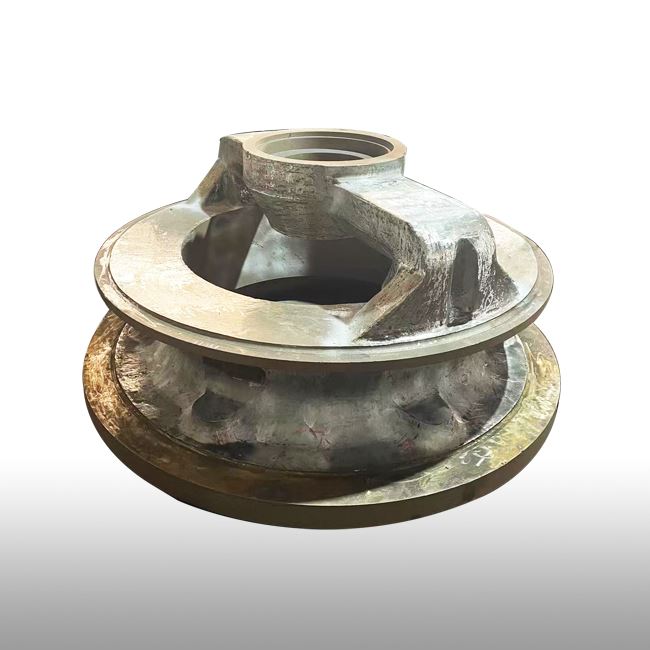
Apart from the main wear parts mentioned above, other components such as Upper And Lower Frame For Cone Crusher and Mining Crusher Parts Hammerhead also play a role in the overall crushing process.
In a cone crusher, the upper and lower frames need to be in good condition to ensure proper alignment and operation. Any wear or damage to these frames can affect the crushing chamber geometry, which in turn can influence the particle size distribution.
Hammerheads in a mining crusher are similar to blow bars in an impact crusher. Worn hammerheads can lead to inefficient crushing and a wider particle size distribution.
Conclusion
The condition of impact crusher wear parts has a profound influence on the particle size distribution of the crushed material. From blow bars and aprons to liners and rotor components, each wear part plays a crucial role in the crushing process.
As a supplier of high - quality Impact Crusher Wear Parts, we understand the importance of providing reliable and durable wear parts to our customers. Our products are designed to withstand the harsh conditions of crushing operations and maintain their performance over a long period.
If you are experiencing issues with the particle size distribution of your crushed material or are looking to improve the efficiency of your impact crusher, we encourage you to contact us. Our team of experts can provide you with the right wear parts solutions and advice to meet your specific needs. Let's work together to optimize your crushing operations and achieve the best possible particle size distribution for your products.
References
- Evertsson, C. (2001). Prediction of wear in crushers. Minerals Engineering, 14(11), 1319 - 1328.
- Mishra, B. K., & Rajamani, R. K. (2006). Size reduction. Mineral Processing Design and Operations: An Introduction. Butterworth - Heinemann.
- York, A. (2012). Crusher wear parts: A guide to selection and maintenance. Quarry Management.